
Quick Answer:
Grounding, also called earthing, has been studied scientifically, but its proposed health benefits are not established by strong clinical evidence. Small studies have reported improvements in sleep and other outcomes, including a 2025 randomized trial. However, larger, independently replicated studies are needed before grounding can be considered a proven treatment.
That distinction matters. Saying grounding has “no research” overlooks published studies. Saying those studies prove that grounding reduces inflammation, balances hormones, or treats disease goes beyond what the evidence can establish.
To understand where the science stands, we need to look beyond the number of papers and examine what researchers tested, what they found, and how confidently those findings apply to everyday use.
What Is Grounding?
Grounding is the practice of connecting your body electrically to Earth. This can involve direct contact with the ground, such as standing barefoot on soil, or using conductive equipment connected to an appropriate grounding point.
Grounding products include mats, mattress pads, sheets, and patches. Researchers have used several of these methods, which is one reason findings from a particular study may not apply directly to every grounding product.
Earthing is also different from psychological grounding. Psychological grounding techniques direct your attention to the present moment—for example, by identifying things you can see, hear, and feel. Those exercises do not require an electrical connection to Earth.
Electrical connection and health benefits are separate questions
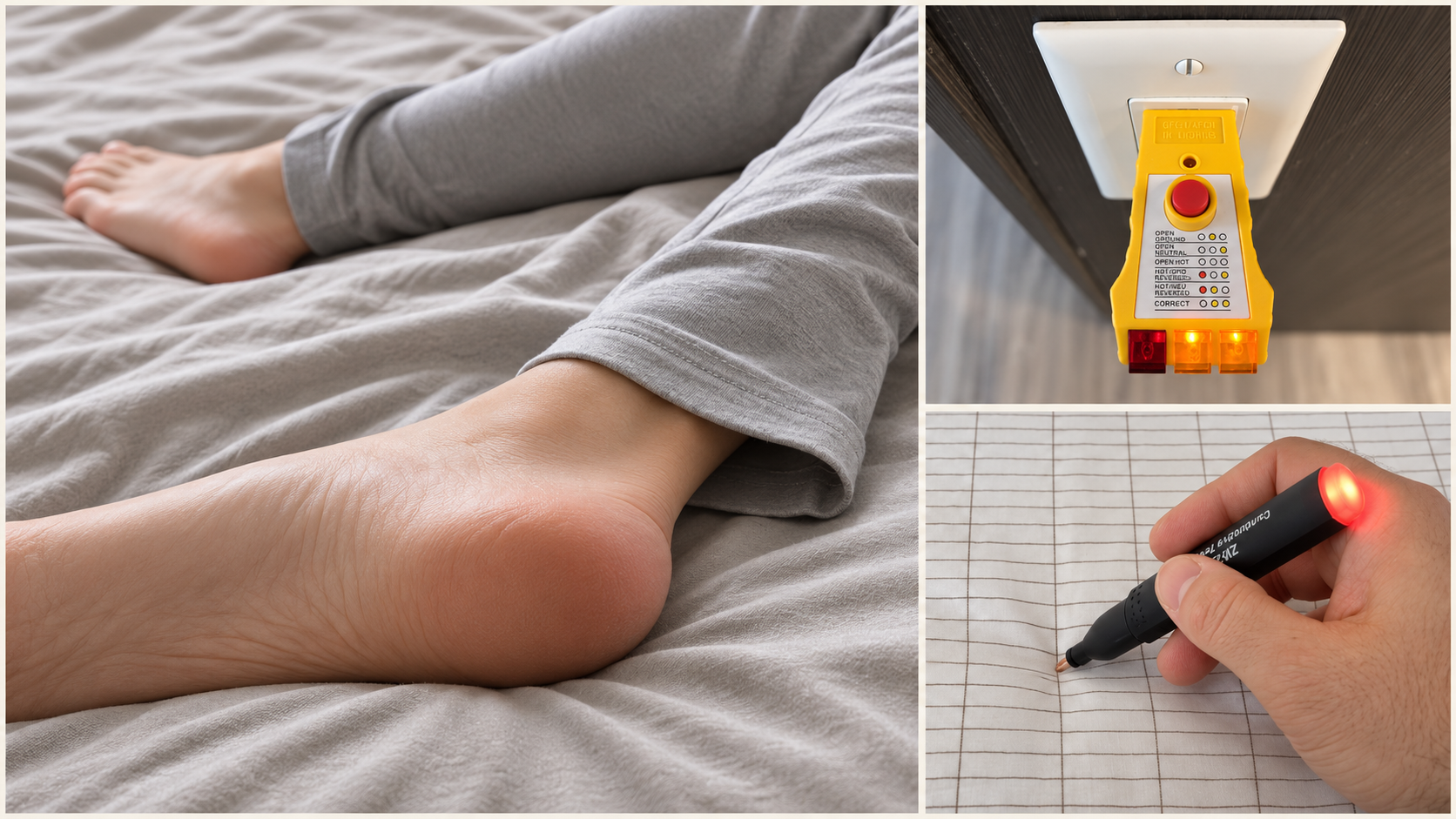
A central distinction in grounding research is the difference between demonstrating an electrical effect and demonstrating a health benefit.
A voltage measurement may help illustrate what happens electrically when a person connects to a grounding point. It does not measure sleep quality, inflammation, pain relief, or disease risk.
Establishing a health benefit requires clinical research that measures those outcomes and compares them with an appropriate control.
For more on the equipment and connection itself, see our guide to how grounding sheets work.
What Would “Scientifically Proven” Mean?
In health research, confidence usually develops across multiple well-designed studies rather than from one positive experiment.
Useful questions include:
- Were participants randomly assigned to treatment and control groups?
- Did the control group use convincing sham equipment?
- Did participants and researchers know which treatment people received?
- Was the study large enough to produce reliable estimates?
- Were improvements meaningful in everyday life?
- Have independent researchers reproduced the findings?
A small pilot study can identify an interesting signal and justify further research. It generally cannot establish that a treatment works reliably across different people, products, and conditions.
That is the context needed to interpret grounding studies.
What Does Scientific Research Say About Grounding?
Published grounding research includes small pilot studies, controlled trials, and reviews. Some findings are positive, but their meaning depends on the study design and the outcome measured.
The following examples illustrate the evidence commonly cited in discussions of grounding. They are not a complete systematic review.
Grounding Research: Findings and Limitations
Three grounding studies, what researchers reported, and the qualifications that matter when interpreting their results.
Scroll horizontally to compare all four columns.
| Research | Participants and design | What researchers reported | Main qualification |
|---|---|---|---|
| 2004 Sleep and cortisol pilot | 12 participants using grounded mattress pads for eight weeks. | Changes in cortisol profiles and improvements in self-reported symptoms. | Small before-and-after study without a separate comparison group. |
| 2015 Muscle damage study | 32 men randomized to grounding or sham grounding. | Differences in creatine kinase following exercise. | Short exercise study with a narrow population and outcome. |
| 2025 Sleep trial | 60 participants assigned to grounding or non-grounding mats for 31 days. | Improvements in several measures, including greater total sleep time compared with controls. | One trial does not establish consistent benefits across products and populations. |
Grounding and sleep: the 2025 randomized trial
A 2025 study tested grounding mats in 60 participants assigned by computer randomization to either a grounding mat or a non-grounding control mat.
Participants were instructed to use their assigned mat for six hours daily over 31 days. Researchers assessed sleep and stress using questionnaires and measured total sleep time with actigraphy, which uses a wearable device to estimate sleep from movement.
The researchers reported improvements in several questionnaire scores within the grounding group. They also reported that total sleep time increased significantly compared with the control group. At the follow-up assessment, insomnia severity scores showed a significant improvement relative to controls. www.sciencedirect.com

This trial contributes more informative evidence than a testimonial or an uncontrolled observation because it included randomization and a placebo comparison.
However, the findings still need to be interpreted carefully. Improvement compared with a person’s own baseline is different from improvement compared with the control group. The latter helps determine whether grounding produced an effect beyond other changes occurring during the study.
The trial also tested mats under specific conditions. It does not establish that every grounding sheet, mattress pad, or other product will produce the same results.
Grounding and cortisol: the 2004 pilot study
A frequently cited 2004 study followed 12 people with complaints involving sleep, pain, and stress.
Participants slept on grounded conductive mattress pads for eight weeks. Researchers collected saliva samples to evaluate daily cortisol patterns and recorded participants’ subjective symptoms.
The authors reported changes in cortisol profiles, including reduced nighttime cortisol, alongside improvements in self-reported sleep, pain, and stress. journals.sagepub.com
The limitation is the design: this was a small before-and-after investigation without a separate comparison group. It could identify changes during the study, but it could not reliably establish how much of that change was caused by grounding.
The study is a reason to investigate further. It is not sufficient evidence for a broad claim that grounding “balances hormones” or treats elevated cortisol.
Grounding and muscle recovery: the 2015 study
A 2015 study randomized 32 healthy men to grounded or sham-grounded groups after an exercise protocol designed to induce muscle damage.
Researchers reported that grounding reduced the rise in creatine kinase, a blood marker associated with muscle damage. The authors concluded that the results warranted further study. pmc.ncbi.nlm.nih.gov
This finding concerns a particular marker following a particular exercise protocol. It does not demonstrate that grounding treats chronic pain, prevents injury, or reduces inflammation throughout the body.
Those broader claims would require research that directly measures those outcomes.
What about the widely shared 2015 inflammation paper?
Another frequently referenced publication is the 2015 paper titled The Effects of Grounding (Earthing) on Inflammation, the Immune Response, Wound Healing, and Prevention and Treatment of Chronic Inflammatory and Autoimmune Diseases.
This paper reviews and discusses grounding research, case observations, and proposed mechanisms. It is not a large new clinical trial demonstrating all the benefits named in its title. The authors acknowledge that much of the underlying research involved relatively few participants. pmc.ncbi.nlm.nih.gov
When evaluating a review, the important question is how strong the supporting studies are—not simply how many potential applications the paper discusses.
Also, a paper appearing in PubMed Central does not make it an “NIH study.” Identify the researchers and journal rather than treating the website hosting the paper as its author or an endorsement of its conclusions.
Why Isn’t Grounding Considered Scientifically Established?
The uncertainty comes from the strength and scope of the evidence.
Small studies leave substantial uncertainty
A small study can produce a real finding, but its estimate may be imprecise or sensitive to the characteristics of a few participants.
Larger studies help researchers determine whether an apparent effect is consistent and which groups, if any, are most likely to benefit.
Before-and-after improvement does not establish causation
People’s symptoms change over time. Sleep may improve as stress decreases, routines change, or a temporary problem resolves.
Without an appropriate comparison group, researchers cannot confidently separate the intervention’s effects from these other influences.
Statistical significance does not necessarily mean a noticeable benefit
A statistically significant result does not, by itself, explain how large or useful an effect is.
For example, a sleep study should ideally show the size of the difference between groups and whether that difference is meaningful to participants—not simply report that a statistical threshold was met.
Findings need independent replication
Confidence increases when other research teams reproduce a result using sound methods.
Repeated positive findings across independent groups would provide stronger support than relying on a small collection of studies from a limited research network.
One outcome cannot establish every advertised benefit
Evidence about a sleep questionnaire does not establish an effect on inflammation. A change in a blood marker does not establish disease prevention.
Each health claim needs evidence that directly addresses it.
Is Grounding Pseudoscience—or Is It Understudied?
Grounding can be investigated scientifically. Researchers can compare electrically grounded and sham-grounded equipment, measure outcomes, and test whether results are reproducible.

The problem arises when preliminary findings or proposed explanations are presented as established medical facts.
Claims that grounding reliably treats numerous unrelated diseases require much stronger evidence than the studies discussed here provide. Conversely, dismissing the subject as something that has never been tested also misrepresents the published research.
A more accurate position is that grounding has preliminary clinical evidence, while its broader health claims remain unproven.
That leaves room for further investigation without treating uncertainty as confirmation.
Could Grounding Benefits Be Explained by Placebo or Time Outdoors?
Yes, these are possible explanations that research needs to address.
Someone who begins grounding may also start going outside more often, taking quiet breaks, changing their bedtime routine, or paying closer attention to sleep.
Expectations can influence how people experience and report symptoms. Natural changes in symptoms can also coincide with starting a new practice.
This does not mean someone’s improvement is imaginary. It means an improvement alone cannot identify its cause.
Outdoor grounding introduces an additional challenge: time in nature, movement, and relaxation may contribute to how someone feels. Cleveland Clinic highlights this difficulty when distinguishing the possible effects of earthing from the benefits of being outside. health.clevelandclinic.org
Well-designed indoor trials using convincing sham equipment help researchers investigate whether the electrical connection itself makes a difference.
What Does This Mean for Grounding Mats and Sheets?
The evidence should be evaluated at the level of the product, method, and outcome studied.
A trial using a grounding mat does not automatically validate every grounding sheet sold commercially. Differences in equipment, use, participants, and measured outcomes can limit how directly the findings apply.
There are also two separate product questions:
- Does the product provide the intended electrical connection?
- Does using it produce a meaningful health benefit?
Conductivity testing can help address the first question. Clinical trials are needed to address the second.
Commercial disclosure: AP Wellness sells grounding products. This article distinguishes product function from health outcomes that still require stronger evidence.
For consumers, the most defensible expectations are cautious ones. Grounding products should not be presented as proven treatments or substitutes for medical care. Nebraska Medicine similarly describes the evidence for grounding devices as insufficient for definitive recommendations. www.nebraskamed.com
Safety also deserves attention. Outdoor barefoot contact can involve cuts and infections, while indoor equipment requires appropriate connections and careful adherence to safety instructions. People with reduced foot sensation or other relevant medical concerns should discuss barefoot practices with their clinician. health.clevelandclinic.org
What Research Would Make the Evidence More Convincing?
Stronger grounding evidence would come from larger trials that address the limitations of earlier work.
Particularly useful features would include:
- Preregistered methods: documenting the study plan and primary outcomes before results are known.
- Credible sham controls: making treatment and control equipment difficult to distinguish.
- Checks on blinding: assessing whether participants correctly guessed their group.
- Objective and subjective outcomes: combining measurements with participants’ experiences.
- Meaningful effect sizes: showing how much benefit occurred, with estimates of uncertainty.
- Independent replication: reproducing findings through separate research teams.
- Longer follow-up: determining whether any benefits persist.
Funding, equipment provision, and author relationships should also be disclosed. Such relationships do not automatically invalidate research, but transparent reporting helps readers evaluate it.
Frequently Asked Questions About Grounding Research
Is there any scientific evidence for grounding?
Yes. Published studies include pilot investigations and controlled trials examining sleep, cortisol patterns, and exercise-related outcomes. Some report positive findings. However, the existence of research does not establish that grounding reliably produces its advertised benefits. Study quality, size, replication, and the specific outcome all matter.
Do doctors recommend grounding?
Medical opinions vary. Cleveland Clinic describes grounding’s specific health claims as unproven, while Nebraska Medicine notes that evidence for devices is insufficient for definitive guidance. A clinician may support suitable outdoor activity without endorsing grounding products as proven treatments.
Are grounding mats a hoax?
Whether a mat provides an electrical connection is separate from whether it improves health. Evaluate the product’s construction and testing, then examine the evidence behind each advertised benefit. A functioning electrical connection does not establish clinical effectiveness, and preliminary studies do not justify claims that grounding treats disease.
Does grounding lower cortisol?
A 2004 pilot study involving 12 participants reported changes in cortisol patterns during grounded sleep. Its small size and lack of a separate comparison group prevent a firm conclusion that grounding caused those changes. Larger controlled studies are needed before treating cortisol reduction as an established benefit.
Does walking barefoot indoors count as grounding?
Bare feet alone do not establish an electrical connection to Earth. The answer depends on whether the surface provides a conductive path to ground. Even when an electrical connection exists, that does not demonstrate a health benefit. The physical connection and the proposed clinical effects remain separate questions.
Does a lower body-voltage reading prove grounding works?
It may demonstrate a change in the electrical measurement under the test conditions. It does not measure inflammation, cortisol, sleep quality, or pain. A multimeter demonstration can illustrate an electrical effect, but it cannot replace a controlled clinical study of health outcomes.


Leave a Reply