
Quick Answer:
A properly made grounding sheet connected as directed to a correctly wired, grounded outlet should not expose you to the outlet’s live electrical supply. But it would be misleading to promise that electrocution is impossible. Faulty wiring, a damaged or incorrectly made cord, contact with another faulty electrical device, and lightning-related surges can create hazards. If you feel a shock or tingling, stop using the sheet and have the setup checked.
Does a grounding sheet use electricity from the outlet?
An outlet-connected grounding sheet is designed to connect its conductive fibers to the outlet’s ground contact, not its energized hot or neutral contacts. It is not an electric blanket: it has no heater and should not be powered by household voltage. The conductive fabric provides a path to the electrical ground when the outlet and product are functioning as intended.
That distinction explains why ordinary use is different from touching a live wire. It does not mean every outlet or every product is safe.
A ground connection is a protective part of a home’s electrical system, but grounding itself does not guarantee that a person cannot be shocked by defective equipment. The Electrical Safety Foundation International (ESFI) describes grounding as a protection against shock, while CDC/NIOSH explicitly warns that it does not eliminate injury from defective equipment.
When could a grounding sheet pose an electrical risk?
1. The outlet or home wiring has a fault
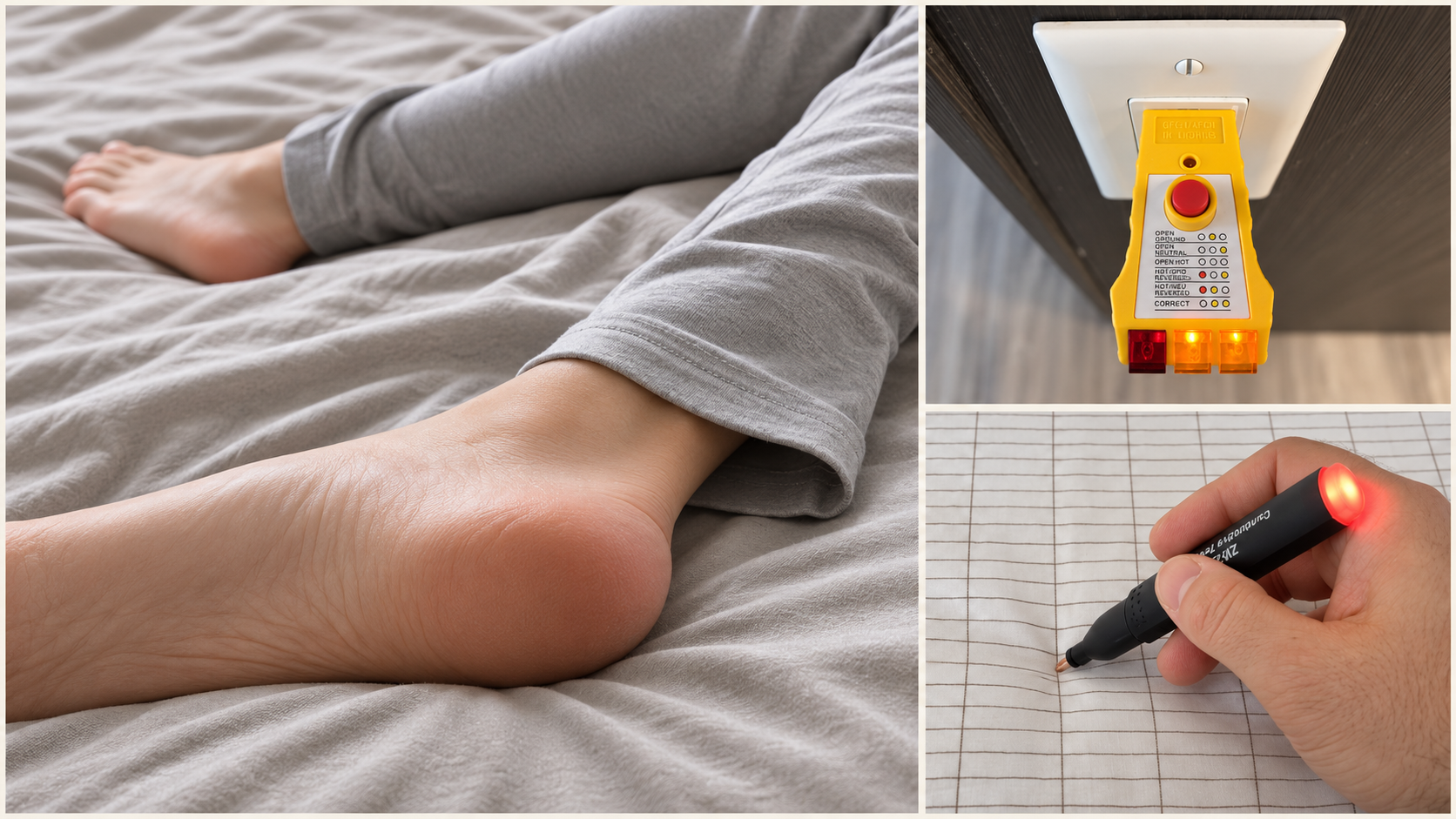
An ungrounded, damaged, or incorrectly wired receptacle may not provide the connection the product expects. Do not assume that a three-hole outlet is correctly grounded just because a plug fits. If an outlet tester shows a fault, leave that outlet unused for the sheet and ask a qualified electrician to investigate. A simple plug-in tester is a screening tool, not a complete inspection of the home’s wiring.
2. The sheet, plug, adapter, or cord is damaged or altered
Frayed insulation, exposed conductors, a loose connector, overheating, or an unknown replacement cord are reasons to stop using the product. Follow the maker’s instructions for the exact sheet and cord; do not bypass a built-in resistor, fuse, or adapter or improvise a connection to another outlet contact. ESFI advises regular cord inspection and replacement of damaged electrical items. [3]
Some brands put a current-limiting resistor in the cord. It can reduce current through that particular path in certain fault scenarios, but its presence and value vary by product. It is not a blanket guarantee against every electrical fault, lightning surge, or shock involving another device. Check the specifications of your own cord rather than assuming every sheet contains a 100 kΩ resistor.
3. Another electrical device is faulty
Grounding your body does not repair a defective phone charger, electric blanket, bedside lamp, or other appliance. If a faulty device energizes something you touch, current may find a path through your body. Avoid using visibly damaged devices around the bed. A ground-fault circuit interrupter (GFCI) can reduce shock risk by quickly interrupting a ground fault, but it does not make unsafe equipment safe. [4]
4. There is a thunderstorm
Lightning can travel through a building’s electrical wiring. As a practical precaution, disconnect the sheet before a storm arrives and leave it disconnected until the storm passes. If lightning or thunder is already occurring, do not reach for the outlet, cord, or other electrical equipment just to unplug it. The CDC advises staying away from electrical equipment and cords during a thunderstorm.
How to use a grounding sheet more safely


- Read the product instructions. Use the supplied, compatible cord and adapter exactly as directed. Confirm which contact the plug is intended to use.
- Check the outlet. Use the manufacturer’s outlet checker if supplied. If it indicates a fault, if the outlet is loose, warm, buzzing, discolored, or gives you a tingle, stop and consult a licensed electrician. A tester result alone cannot certify the entire wiring system.
- Inspect before connecting. Look over the plug, cord, connector, and conductive fabric. Replace damaged components with manufacturer-approved parts.
- Keep the connection dry and intact. Unplug before washing, and do not reconnect until the sheet and connector are fully dry. Follow the care label.
- Treat any shock as a warning. Stop using the sheet. Do not keep trying it in other outlets to see whether the sensation repeats. If the plug or outlet appears damaged or energized, avoid touching it and contact an electrician. ESFI identifies even a mild shock or tingle as a possible sign of an electrical problem. [6]
- Disconnect ahead of severe weather. Plan ahead rather than handling cords during lightning. [5]
Grounding sheet safety
Frequently asked questions
Can a grounding sheet shock you while you sleep?
It should not deliver household voltage during normal use with an intact product and a correctly wired outlet. A shock is not a normal feature of grounding. Stop using the sheet if you feel one, and have the product and outlet evaluated.
Why do I feel a small zap or tingling from my grounding sheet?
It might be static electricity, but do not assume that is the explanation, especially if it recurs while the sheet is connected. Disconnect the sheet when safe to do so and check for damaged components or an electrical fault. A licensed electrician can assess the outlet; the manufacturer can assess its product.
Does a grounding sheet draw power?
A conventional ground-only sheet is not meant to draw power to run a heater or motor. Its connection to the ground contact does not mean its fabric is supplied with 120-volt household power. Check your specific product’s design before making that assumption.
Is a built-in safety resistor enough to prevent electrocution?
No single component is a universal guarantee. A resistor may limit current along the cord under certain conditions, but it does not correct faulty wiring, a damaged product, an unsafe appliance nearby, or a lightning hazard. Its value and placement must be verified for the specific product.
Can I use a grounding sheet in a two-prong outlet?
Do not use an improvised adapter or assume a two-prong outlet provides a ground. Follow the manufacturer’s instructions and have an electrician advise you about a suitable grounding connection. ESFI warns against defeating the grounding connection to force a plug to fit.
Are grounding sheets safe during thunderstorms?
Disconnect them before the storm as a precaution. Once thunder or lightning is underway, avoid handling the cord or outlet; the CDC advises avoiding electrical cords and equipment during thunderstorms.
Sources & references
- ESFI — Understanding Your Home Electrical System
- CDC/NIOSH — Electrical Safety: Safety and Health for Electrical Trades (PDF)
- ESFI — Back to School Electrical Safety Tips
- ESFI — Ground Fault Circuit Interrupters
- CDC — Safety Guidelines: Lightning
- ESFI — Electrical Warning Signs
- ESFI — Extension Cord Safety Tips


Leave a Reply